
A littoral cell is a coastal section that contains one cycle of sedimentation including sources, transport paths, and deposit sinks.
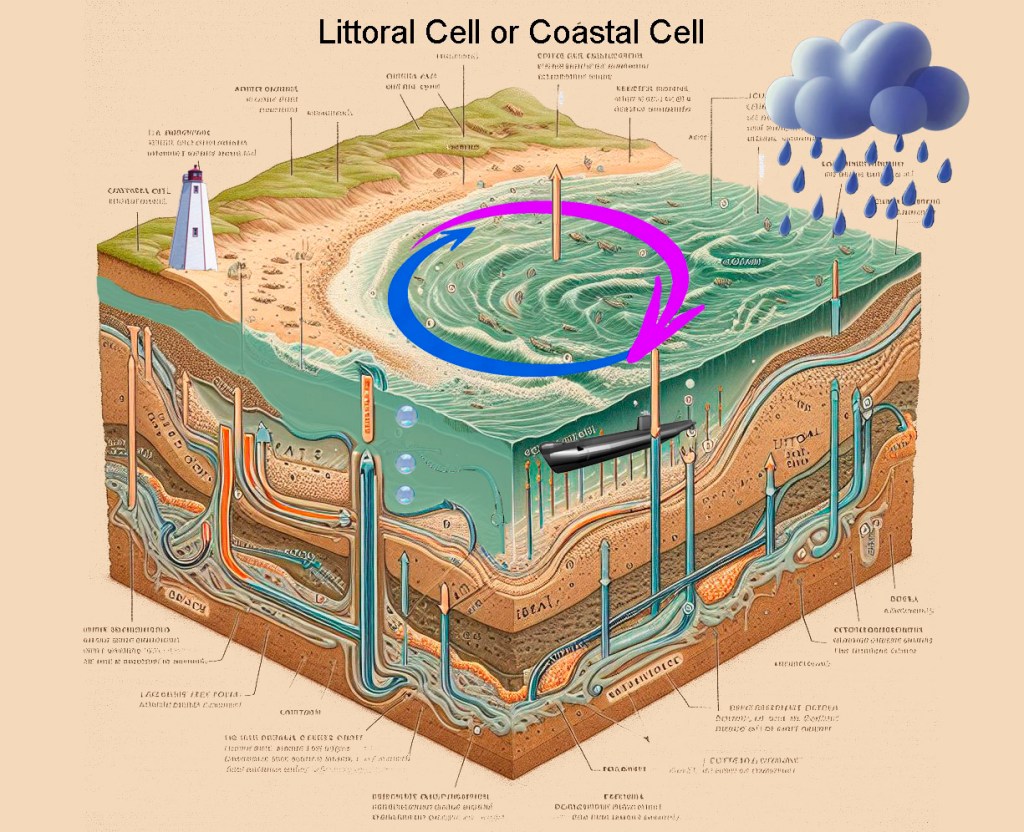
This littoral illustration should not be taken literally.
Conceptually a littoral cell is a closed system where the water and sediment are contained. Of course there are no such idealized cells. Incursions to littoral cells can include precipitation; evaporation; ground water movements; spilled drinks; unmentionable releases; stream inflows; water extractions; silt, water and sediment exchanges with bordering water currents; and ground collapses due to hydrostatic pressures. Over time, and certainly over geological times, their existence and patterns will change.
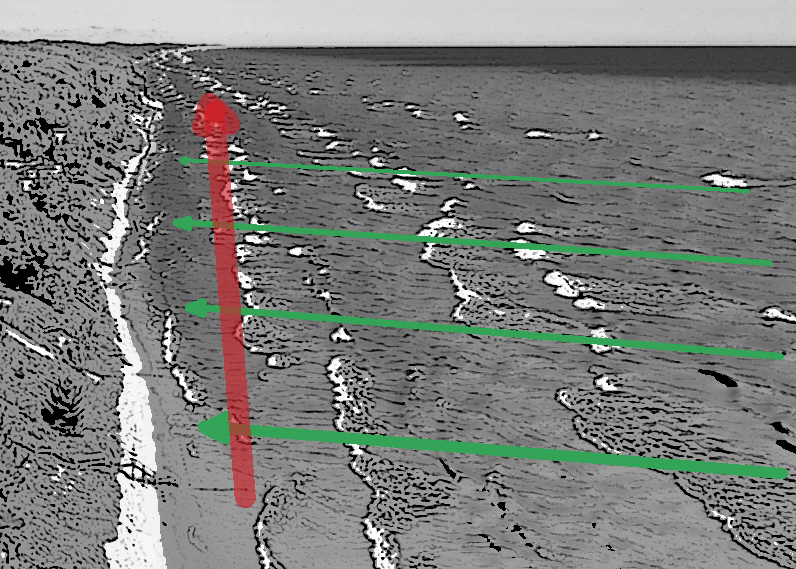
Littoral drift refers to the net movement of sediment such as sand grains in the directions of the longshore current. The longshore current generally moves parallel to the shoreline and is driven by the prevailing winds. As the wind direction can vary, so can the velocity (speed or direction) of the littoral drift. The momentum of the longshore currents will cause a delay in reacting to wind changes.
Rip currents are not the same as the currents that run parallel to the shore. They tend to be perpendicular to the shore and away from the shore. They are caused when water is pushed toward the shore (tides, seiches, waves, tsunamis, air pressure changes), and then due to gravity, the water returns back offshore by running through the gaps between sand bars. Littoral drifts are due to the frictional drag of the air against the water’s surface and include the shoreline sediment or sand with the water.
 someofabeach.ca