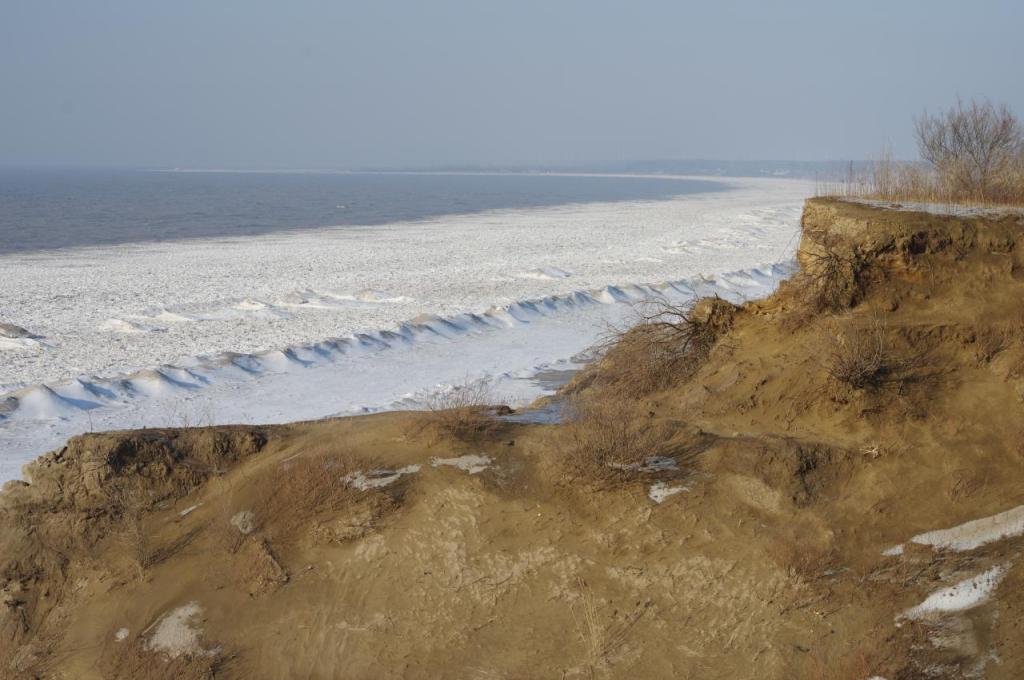
Scenes such as this winter shoreline ice are becoming infrequent – the winter lake ice protecting the shoreline for a few months of the year.
Climate Damage
It is useful to distinguish between climate change, which is a combination of natural and manmade effects, and that portion of the changes due entirely to human activities (anthropogenic) – climate damage.
We are conducting a vast and irreversible experiment with Earth’s environment. As we continue to experiment with Earth, we are getting a better understanding of the effects that generated heat from human activities and the secondary effects of chemical by‑products that are added to the atmosphere.
As of 2009 it was estimated that at least 135,000,000,000 barrels of oil had been extracted from the earth. Since that time approximately another 90,000,000 barrels are extracted and used each day (93,500,000 daily as of 2017). Most of it is burned. It appears that first figure of 135 billion barrels is far too low, as the second, more recent and more easily measured figures, means over 300 billion barrels have been used in just the latest ten years – more than twice the 2009 estimate!
Regardless, it is difficult to comprehend these huge quantities. Try to imagine if these annual resources were used in just one a day. If each adult and child on the Earth today burned their yearly per capita portion in one day, that would be like each person going out in the morning and burning more than 4 barrels of petroleum on their balcony, or in their yard, or local park – wherever each could find a place with enough oxygen. And then in the afternoon burning one’s per capita share of the coal and natural gas used. Such estimates are difficult to accurately produce, but currently over 3 billion tonnes of coal are used each year. That is roughly half a tonne per person per year. Even making a very low estimate of total coal mined to date, suppose that afternoon while those barrels of petroleum were still burning, each child, woman and man burned ½ tonne of coal, if there would even be enough space to do it. Then there is the natural gas. You get the picture. In many respects we have do the equivalent, and more, but spread over more time.
In parallel with these combustion/chemical reaction activities, there is the increasing deforestation, at a rate, if continued, to remove all remaining trees from the earth during this century.
Of course, Lake Erie is affected. What are some of the effects?
- Atmosphere – weather cycles can be faster and more extreme when driven by the additional solar energy captured under the chemical blanket.
- New weather patterns that move hot air where is normally doesn’t go. Patterns the move cold air where is normally doesn’t go. More mixing of the lower and upper atmosphere. More precipitation directly affects ground water. Ground water directly affects slope stability.
- Less ice – in the region of the Great Lakes, less ice means more lake evaporation, and that means more precipitation downwind.
- Deforestation means higher water tables in Lake Erie’s watersheds as deep rooted, year-round functioning plants (trees) are replaced with shallow rooted, single season plants – much less evaporation of the precipitation and much more ground water seeping into the lake, and more runoff.
Click here to see the current chart of historical Lake Erie surface water temperatures from 1995 to date.
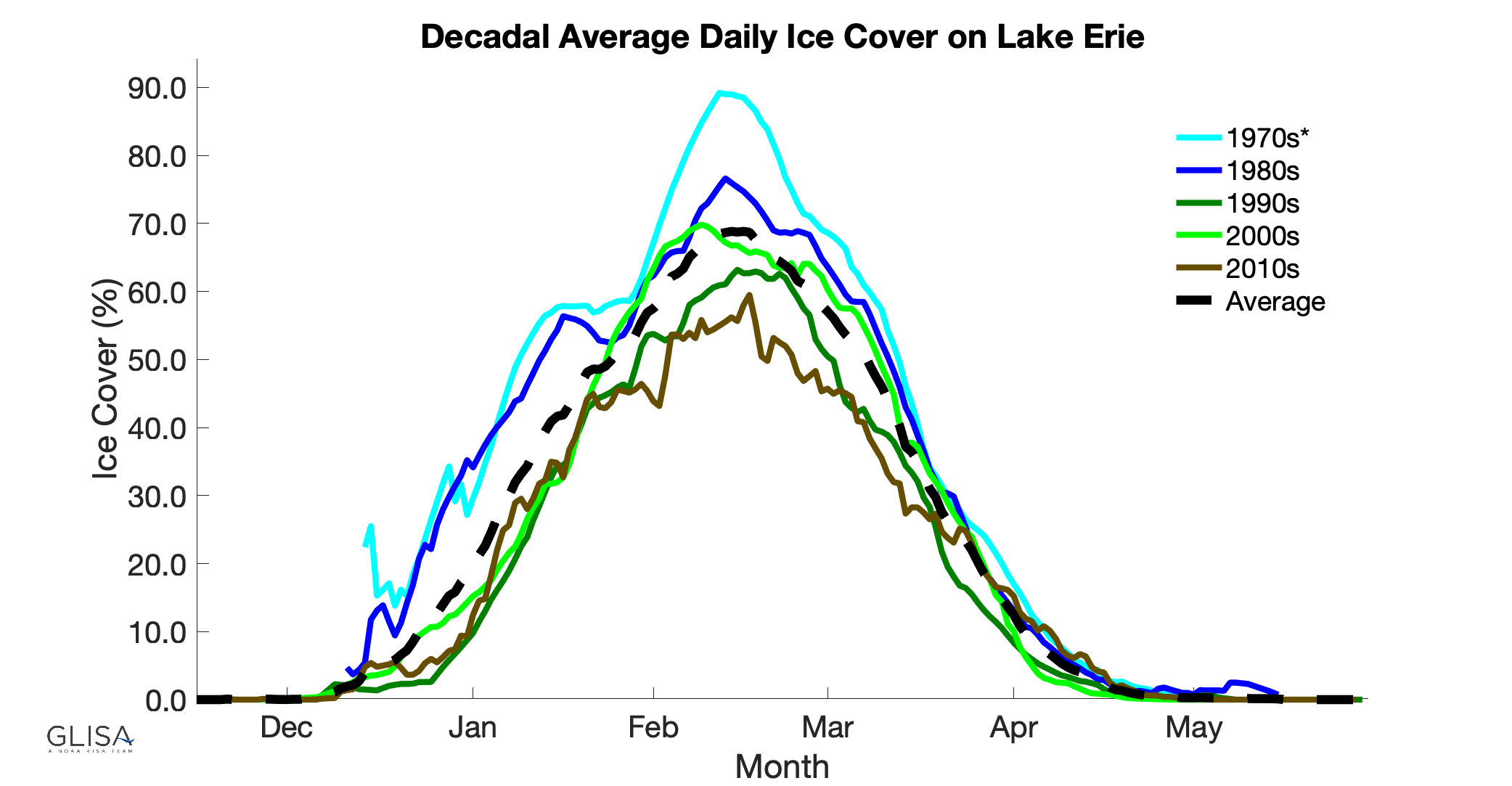
Here one can view the Lake Erie ice coverage data averaged for each of the latest five decades. Indications are the 2020s will have even less.
And for some historical water levels data, click here.
So the lake is warming, the surface winds are hitting the surface nearly all year long, the average winds are stronger due to climate damage, and more groundwater flow is carrying more sand and silt into the lake. Do these combined effects not alter the lake’s currents? There is more sand and silt in the lake than ever before, yet not much of it is coming ashore as beaches.
 someofabeach.ca