
Where does if come from, what does it do, and where is it going?
Clay minerals generally form from chemical weathering of silicate-bearing rocks. Chemical weathering takes place largely by acid hydrolysis due to low concentrations of carbonic acid, dissolved in rainwater or released by plant roots. Much of the clay found in our region may have originated before or between the ice ages and settled in some of the deeper portions of Lake Algonquin, the forerunner of the Great Lakes.
Some carefully researched prehistory by a variety of researchers of the Great Lakes can be found here.
There are different types of clay, and although clay is inorganic, the chemistry of clay formation and therefore the type of clay can be influenced by the presence of bacteria. Bacteria has been found as much as 3 km below ground.
Although chemically there are various clays, they all have very small grain sizes, from about .005 mm to colloidal dimensions (between 0.001 mm and 0.000001 mm in diameter). In contrast, sand grains are about 1 mm in diameter, or about 200 to a million times larger than clay grains. Hence clay can be much more easily transported by water.
There are significant portions of clay in some of the soil of Elgin and Norfolk Counties. In some of the ‘dry’ land, nearshore areas, it can be found in high concentrations, or on the other extreme, nearly absent from sand deposits. Elsewhere it can be found fully blended with the other soil components and comprising much of the soil’s content.
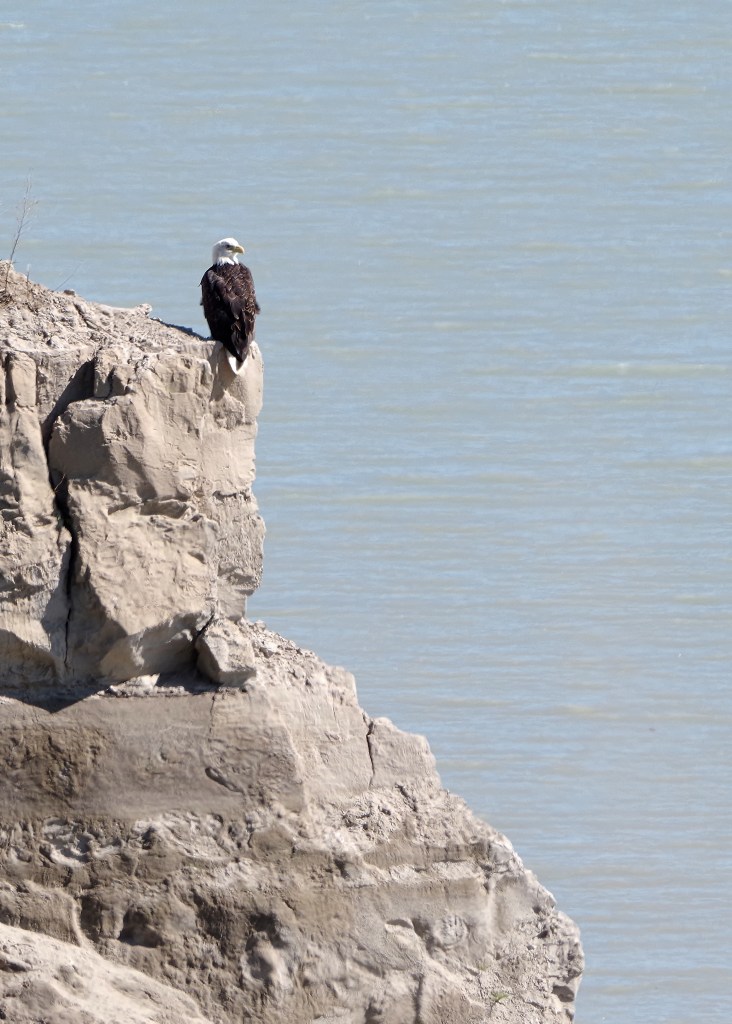
Clay concentrations can form flying buttresses at the cliffs where the neighboring sand erodes first.
What does clay do? When blended into the soil, if the soil is not laden with water, it makes the soil firmer and sturdier by acting as a binding agent. It can also limit the permeability of the soil making the soil resistant to ground water flow. When the clay does enter the lake, it settles to the bottom much more slowly than sand. Hence it may travel much farther in any given time frame than sand.

Clay can slow or block the flow of water through soil. If groundwater is traveling through porous sandy soil, but is transporting some clay, over time that clay can cause a sufficient blockage with the seeping water that the underground ‘stream’ may find an alternate path of least resistance and burst forth from a new cliff location.
 someofabeach.ca