
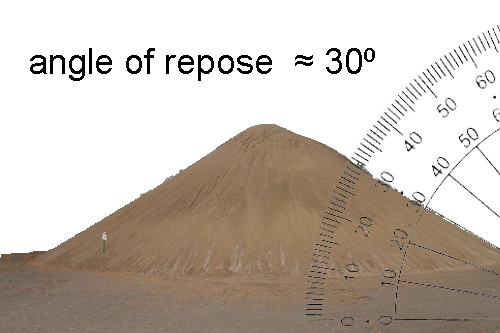
What is this and why is it relevant to the erosion? First, the definition. The angle of repose, or the critical angle of repose, of a granular material is the steepest angle relative to the horizontal plane which a material can be piled without slumping or the surface material sliding. Shown below is an example where the angle of repose is about 30⁰.
Damp sand (sand castle) has a steeper angle of repose than dry sand (hour glass). Very wet sand (sand under water) has a very small angle of repose. Water by itself has a zero angle of repose. Damp clay can act as a weak adhesive. Very wet clay can act as a lubricant. Dry powdered clay can act as a lubricant. My point? The relative proportions of a sand, clay and water mixture will determine the angle of repose. Wave action can further reduce near shore underwater sand. And not all sand is the same. More about this elsewhere.
If the proportion of clay increases in the sand, clay and water mixture, the angle of repose will be reduced. Might this in affect the slope of the bottom close to the beach. Add decades of processed sewage to the mixture and perhaps the angle of repose is further reduced.
 someofabeach.ca