
Much changed in and near the Long Point region due to the arrival of the primarily European immigrants. The land which was once nearly entirely forested has now be reduced to about 5% forests or less. This has had a dramatic impact on the underground water table, especially with the high bluffs bordering Lake Erie. The forest plants with their deep roots would access water from precipitation for long after rainfalls. In addtion to the deep roots, the trees generated leaf litter that annually added to the soil’s ability to hold water.
As the treed forests were replaced with shallow rooted crops, these new plant species, especially in sandy soil, were dependent upon frequent precipitation, and in some cases, irrigation. In sandy soil, the moisture available to shallow-rooted plants seeps below the plants reach within a couple of days. This causes the soil to accumulate more water at deeper levels, thereby increasing the average density of the land while at the same time making it less viscous (more fluid or plastic).
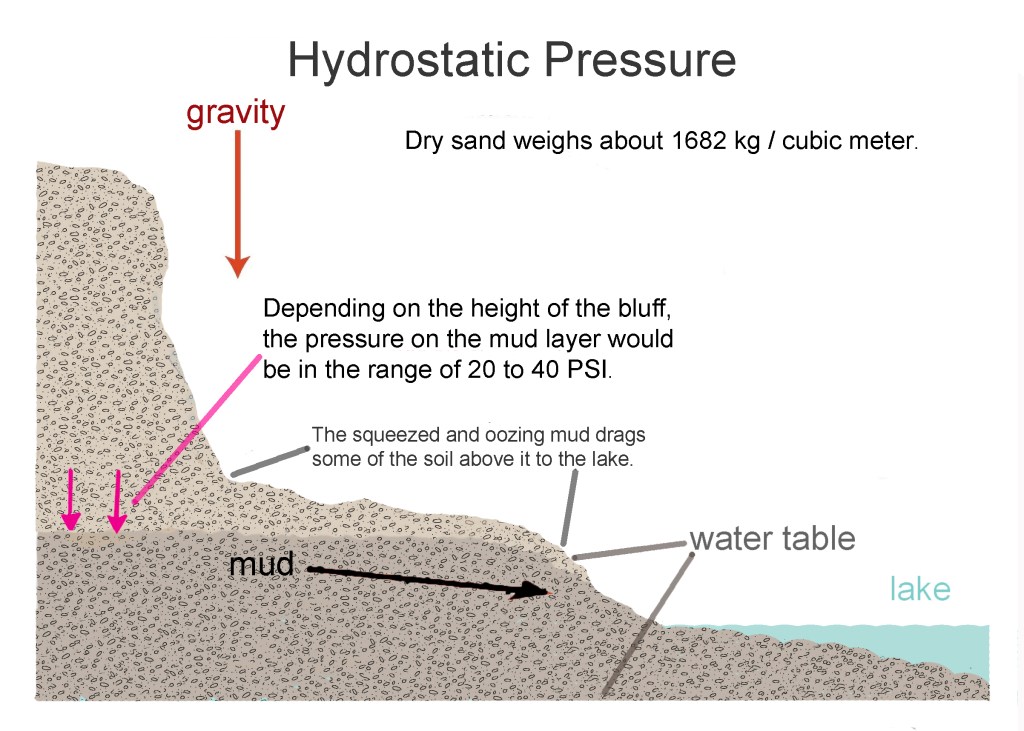
The weight of the thick layer of sand or soil above the muddy layer is very heavy. If that layer above the muddy layer is sufficiently thick, it will squeeze the mud toward the lake. The thicker (heavier) it is, the faster will be the rate of erosion. Depending on the height of the bluff, the pressure on the mud layer would be in the range of 20 to 40 PSI (pounds per square inch). What is that range of pressure like? That is like the pressure of a 500 to 1000 mph constant wind.
Fewer trees, more water in the soil, faster erosion.
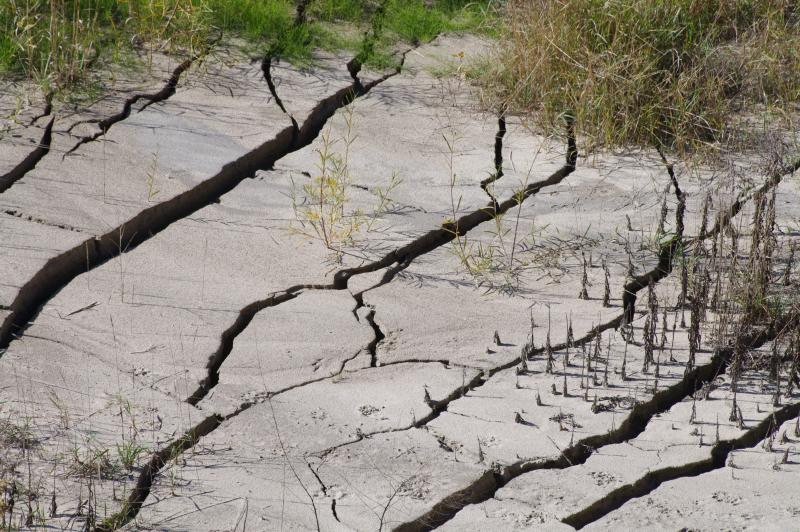
Here is a photo showing drier sand being slowly carried by the wetter sand directly below it. The drier sand has not developed the crevices from drying. The cracks are there because the underlying wet soil (mud-like soil) is accelerating as it is pushed away from the cliffs above by the hydrostatic pressure. This movement and acceleration is not as fast as a snail – if one stands or sits and watches it, is it not be seen to be moving. But if one observes it every few days over a few weeks, the progression becomes obvious.
As the soil reaches the open lake, the combination of the reduced angle of repose caused the by addition of more water to the soil, plus any wave action starts the littoral drift for that mixture of sand, clay and other silt.
Changes of Flora
Many of the plant species that have been and are used agriculturally have escaped to the wild and changed the nature of ‘natural’ fields. Others just came along for the ride. Some commonly seen examples of plants introduced from abroad are clovers (sweet yellow, sweet white, red, and alfalfa), Queen Anne’s Lace (carrots), and vetch. There are others that get more negative attention such a phragmites, dandelions, and purple loosestrife perhaps because they are not part of agribusiness.
Introduced species can and often do displace native species. What the total impact of such changes have been on the stability of soils and fauna cannot be measured as there was no before data collected to compare with the now.
There have also been deliberate efforts to modify forested areas, such as on Long Point when at one time about 100 men worked replacing cottonwood trees with jack and scotch pines. Ponds were also created to attract ducks for duck hunters.
Logging was done on Long Point up until 1951 and is still done in some of the properties owned by conservation authorities to meet their provincially starved budgets.
An indirect effect on the flora of Long Point has been the elimination of wolves and the decrease in coyotes. Without those predators, the plant eating deer and rabbit populations have increased.
 someofabeach.ca